
Ethics Today Is Regulation Tomorrow

Why the firms that stay ahead of regulators are usually the ones already asking the ethics question — not waiting for the rule that will eventually catch up to it.
Here's something we tell every advisor and broker-dealer we work with: ethics and regulation are trying to answer the same question — is this okay for the client? — but they get there on completely different timelines.
Ethics looks forward. You can sit down before you ever act and ask yourself honestly: is this fair, is this honest, am I putting my own interest ahead of my client's? You don't need a rulebook to answer that. Good judgment gets there first.
Regulation, on the other hand, almost always looks backward. Rules get written after something has already gone wrong — after a client gets hurt, a scheme gets uncovered, a gap gets exposed. Reg BI, the custody rule changes that followed the Madoff fraud, years of enforcement cases defining what "suitability" really meant — all of it traces back to misconduct that happened first. The regulation shows up to clean up a mess that ethics could have flagged much earlier.
Why the '40 Act keeps you guessing
This gap is especially real under the Investment Advisers Act of 1940. It isn't a detailed rulebook with a line item for every scenario — it's built on a broad fiduciary principle: act in your client's best interest, and deal honestly with conflicts. That's powerful because it stretches to cover situations no one wrote down in advance. But it also means you can't always point to the statute and get a clean "yes, that's legal" or "no, that's not."
That's not a loophole. It's how the standard is designed to work. Where the text goes quiet, the SEC and the courts fill in the answer over time — through enforcement actions, exam findings, and new rules that eventually put in writing what the fiduciary duty already meant.
If something feels unethical, it's rarely a question of whether it eventually becomes illegal — it's a question of when. Enforcement, case law, or a new rule will get there.
So when one of our advisors asks us, "is this technically allowed?” under a principles-based standard like the '40 Act, the honest answer is sometimes "it's unclear, and it may not stay that way." The better question, and the one we help advisors ask first, is simpler: would this hold up if the client could see exactly what was happening? Get that answer right, and you're usually already ahead of wherever the rule ends up.
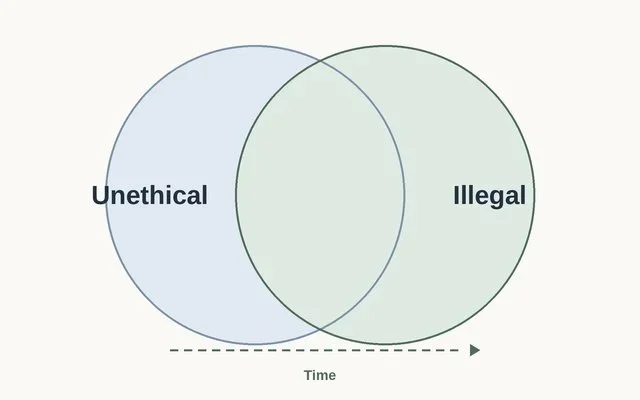
The diagram above tells another story. Over time, regulations are written to address real ethical failures that truly did affect investors. However, this is not perfect science. No rule perfectly addresses the exact scenario it was designed to prevent. Work arounds and unintended consequences all play out overtime as the industry and technology change. In some cases (notably under FINRA) outdated rules stay on the books but are no longer reviewed or enforced, as they pose little risk to the public. Under the SEC, we see the enforcement winds change, and what was a concern in the past is less of a concern in the future, while the rules (or guidance) were never updated. This can leave a different gap on the back end. Ethical practices may be illegal per se, but low risk.
Having a partner that can help navigate both gaps is crucial for the sustainability and efficiency of any investment advisor, broker-dealer, or private fund manager.
Ethics today. Regulation tomorrow. We help you stay ahead of both.