
Compliance Guide to RIA Supervision of Wealth Management
Executive Summary
Applying the supervision rule (Specifically 206(4)-7 of the Advisor’s Act) to small and rapidly growing investment advisors is a tough concept to address. The rule itself gives no direction, SEC guidance is vague, and case law is almost always based on hindsight. For RIA’s with just a few owners who are also the advisors, the rule does not make sense, (how would you supervise yourself?) and for the largest firms, supervision takes the shape of separate internal departments, with their own policies and controls, supported by robust training, systems, and ongoing reviews.
But what about the rest? What about the RIAs that fall in the middle?
What should they do to comply with the supervision rule? And more importantly, how do they ensure all their clients are given great service and advice?
This guide is to help RIAs approach the supervision rule in an intuitive way that fits the risks unique to their business[1].
Starting with the key concepts
By looking at the SEC cases, it is easy to fall into the trap of hindsight. The standard fact pattern goes something like this: John Doe the advisor did a bad or reckless thing, and his client lost money. His RIA gets in trouble for failing to supervise John Doe. The gut reaction when these cases come out is for every firm to add a review to ensure they can prevent or detect the specific thing that John did.
In many cases, that review may be irrelevant or low risk for the firm in question, adding a supervision component that does not solve any real issue, and makes compliance burdensome for no good reason.
The better approach is to start with what services and advice that clients receive, then address the inherent risks from the client’s perspective. After all, every rule traces back to an event that harmed a client.
Notably, these risks change significantly as the number of advisors grow, the complexity of strategies and advice increases, and the list of client commitments grows.
The following three categories provide a framework to work through all the key risks for the client, and therefore, the RIA and its personnel. Each is discussed in detail below.
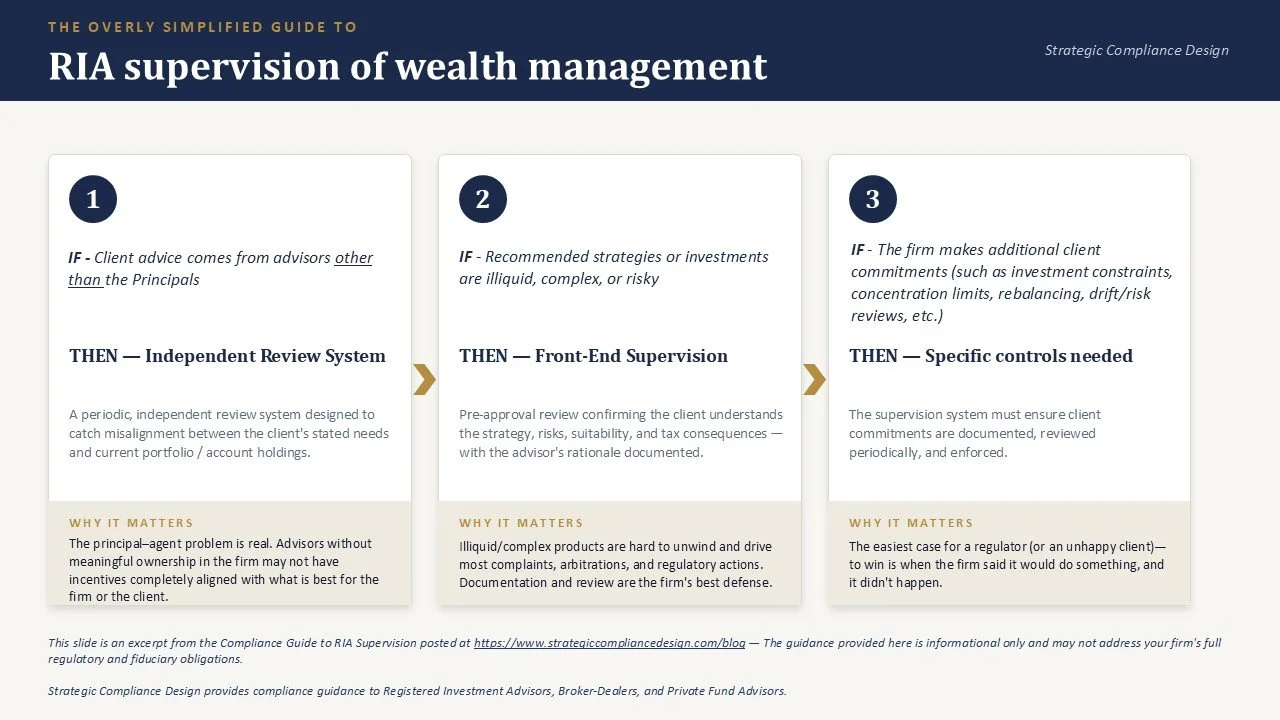
1. The principal-agent problem (addresses firm size & advisor conflicts)
2. Investment Advice - complexity / illiquidity / volatility (addresses inherent risk for client)
3. Client commitments (addresses service and operational standards)
The Principal – Agent problem:
The principal-agent problem becomes increasingly salient as an RIA scales past the point where the founder or a small group of principals can personally oversee every client interaction. In a small practice, the adviser who built the firm typically interacts directly with clients, and their financial interests (firm profitability, reputation, regulatory standing) are tightly aligned with the advice given, since they bear the consequences directly. Once an RIA grows to the point where it employs dozens or hundreds of investment adviser representatives, a wedge opens up between the firm's interests (the principal) and the individual advisers' interests (the agents). Affiliated or employee advisers don't always capture the full value of firm-level outcomes like long-term client retention, reputational capital, or regulatory compliance; they capture compensation tied to whatever metrics the firm uses to pay and promote them. When those metrics diverge from what's actually best for the client or the firm's long-term health, advisors will rationally optimize for the metric rather than the underlying goal, even if unconsciously.
Compensation structure is the central lever here, and it cuts in multiple directions depending on design. Revenue-based or AUM-based grid compensation (where an adviser keeps an increasing percentage of revenue they generate as they cross production thresholds) creates strong incentives to gather assets and grow book size, which is usually aligned with firm growth, but it can also incentivize advisers to chase asset-gathering over service quality, since the compensation formula rewards inflows more than client outcomes. Commission or transaction-based comp, less common in fee-only RIAs but still present in hybrid models, creates a more direct conflict: it rewards activity (trades, product sales, rollovers) rather than advice quality, and can push advisers toward higher-commission products even when a lower-cost option better serves the client. Flat salary models remove the conflict of interest around product selection but introduce a different agency problem: without a productivity link, salaried advisers have a weaker incentive to prospect for new clients, go the extra mile on service, or generate firm revenue at all, since their pay is decoupled from their output. This is the classic "moral hazard" side of the principal-agent problem; effort is hard to observe, so flat pay structures alone tend to undersupply discretionary effort unless paired with non-monetary incentives like career advancement, autonomy, or strong cultural norms.
Growth-stage RIAs add another layer of complexity through team-based or tiered comp plans, where senior advisers earn overrides on the production of junior advisers they supervise or whose books they helped build. This can create healthy mentorship incentives, but it can also incentivize senior advisers to push junior advisers toward higher production targets without commensurate attention to whether those targets serve clients well, since the senior adviser's override income depends on subordinate output rather than subordinate judgment. Similarly, firms that pay differently across product lines (for instance, higher payout on proprietary investment products, in-house insurance, or managed accounts versus simple advisory services) create a structural incentive to steer clients toward the more profitable-to-the-firm option, which is precisely the kind of conflict the SEC's Form ADV Part 2 and fiduciary-duty rules are designed to surface and mitigate through disclosure. The core mitigation tools RIAs use, beyond comp design, are things like centralized investment committees that limit individual adviser discretion over product selection, compliance monitoring of trade and recommendation patterns, client outcome-based metrics (retention, satisfaction, household growth rather than pure AUM growth) folded into comp formulas, and vesting or deferred-comp structures that tie a portion of pay to multi-year retention rather than single-period production, which discourages short-termism and high-pressure sales tactics in the years right before a planned exit or job change.
Some common examples are:
Flat compensation – incentivizes for passive, low touch client service.
Supervision components – oversight of client reviews, client retention metrics.
Variable comp (percentage of revenue based) – incentivizes growth at any cost, may lead to clients that don’t align with firm philosophy, added investment management & operational complexity.
Supervision components – email reviews, product and strategy reviews, exception monitoring.
Independent / % payout-based comp – incentives individual profit, creates misalignment from rest of firm and regulatory standards.
Supervision components - office reviews, product specific reviews (for example: no transaction fee share classes in WRAP accounts) investment standards & oversight.
Incentive based comp (growth targets, retention targets, etc) – Each incentive will create an opportunity to create risk for the firm to boost the numbers.
Supervision components – depends on the metrics used, but each metric will create potential unintended consequences.
While these are complex concepts, structural solutions can provide substantial mitigation as well. Having a team based approach with multiple advisors under different compensation structures work with the same client will help mitigate the different incentives each advisor faces. Larger firms can also segment client types to ensure better alignment between the advisor and the client.
There is no magic approach here. As the RIA grows to the point where more advice is provided by agents, some misalignment will form. That is where the supervision rule comes in. Each firm should start with where the incentives are and provide oversight to ensure any misalignments are mitigated.
Advice Complexity, Illiquidity, and Inherent risk
As the complexity of investment advice increases, so does the surface area for things to go wrong, both for clients and for the firm supervising the advisers who recommend it. Simple, liquid, transparent products (a diversified index fund, for instance) have limited ways to be misused: the risks are well-documented, pricing is observable in real time, and suitability is relatively easy to assess against a client's stated objectives. As advisers move into more complex territory, such as structured products, alternative investments, non-traded REITs, private placements, leveraged or inverse ETFs, complex options strategies, or proprietary in-house vehicles, the number of dimensions where something can go wrong multiplies. Complexity obscures fee structures, makes suitability harder to evaluate objectively, increases the chance that a client doesn't actually understand what they own, and widens the gap between what a well-intentioned but undertrained adviser believes they're recommending and what the product actually does under stress. It also widens the gap that a less well-intentioned adviser can exploit, since complexity makes self-dealing or excessive-fee harvesting harder for both the client and the firm's compliance function to detect after the fact.
This is precisely why complexity should trigger more supervision, not less, and why supervision should happen on the front end rather than relying solely on after-the-fact monitoring. Post-hoc surveillance, things like trade-blotter reviews, exception reports, or periodic account audits, catches problems only after a client is already exposed to the risk, and for illiquid investments, the damage at that point is often difficult or impossible to unwind. A client who was inappropriately placed into a non-traded BDC or a long-lockup private fund can't simply exit the position the way they could sell an overconcentrated stock position once the problem is identified; the illiquidity that made the product risky in the first place is the same illiquidity that prevents a clean correction. That asymmetry, the cost of catching a problem late is far higher for illiquid and complex products than for liquid ones, is the core argument for building a front-end (pre-trade or pre-recommendation) supervisory review specifically for this category of investment.
A front-end review component for complex and illiquid investments serves several distinct functions that after-the-fact review cannot replicate. First, it forces documentation of the suitability rationale at the moment of recommendation, when the adviser's reasoning is freshest and most reviewable, rather than reconstructed later from incomplete records. Second, it allows a second set of eyes, ideally someone with product-specific expertise, to catch concentration risk, liquidity mismatch against the client's time horizon or income needs, or fee layering before the client's capital is committed, while there's still an opportunity to correct course without cost. Third, it creates a natural choke point for enforcing firm-level policies around product approval lists, due diligence requirements, and disclosure delivery, ensuring that only vetted products reach clients and that required risk disclosures were actually provided and understood. Finally, from a regulatory and litigation-risk standpoint, a documented pre-trade review process is strong evidence of a firm's good-faith effort to fulfill its fiduciary and supervisory obligations under the Investment Advisers Act, which matters considerably if a complex product later underperforms and a client alleges unsuitable advice. Given that illiquid and complex products are also the categories most likely to carry elevated compensation for the adviser (the very conflict-of-interest dynamic discussed earlier), pairing front-end supervisory review specifically with this product category closes the gap precisely where the principal-agent misalignment is most acute and where the cost of getting it wrong is least reversible.
The key takeaway here is when investment recommendations are complex, illiquid or highly volatile, the supervision component should include a pre-review and approval component.
Client Commitments
What does your firm promise its clients? Because every promise or commitment is a liability for the RIA.
Granted, some commitments carry more weight than others, and while client service commitments are important, the focus here is on commitments related to items that will affect a client’s portfolio. Every commitment made to a client that may affect their portfolio needs to be monitored. For both regulators and unhappy clients, the easiest finding is an unfilled commitment that resulted in a loss.
Some of these commitments may be buried in marketing materials, the client agreement, or even the ADV. They can take the form of template documents, that the advisor may not realize they are beholden to. I have seen rebalancing commitments, cash sweep commitments, and tax optimizer strategies all committed to in firm-wide documents, where the advisor was unaware. Any firm wide commitment of this nature must have a supervisory control in place to ensure each commitment is honored.
In addition to the above, many of the commitments made are client specific, and can be monitored by the advisor, but complexities arise when the advisor is only one part of a team. Maybe one advisor on-boards the client and makes the commitment, another advisor monitors the investments. Maybe asset management is handled by a central investment team. Anytime multiple parties are involved in sharing responsibility for the commitments made to a client, a supervisory component should be included to ensure commitments are honored.
This list of examples is endless, but here are some of the most common examples:
Ø Investment restrictions:
· Don’t sell X, Don’t buy Y.
· Limit exposure to certain companies / sectors (includes ESG and values-based investing)
· Adherence to other investment constraints (Investment Policy Statements are a common source)
Ø Investment timing / cash treatment:
· When does the client expect a client directed trade to be placed?
· When does excess cash or new money get invested?
· How often are rebalances completed?
Ø Taxes:
· Were any commitments made regarding the client’s tax liability?
· Has the firm taken on any additional tax-related commitments?
Ø Rebalancing:
· Are there any stated or promised rebalancing parameters?
· Is it clear how rebalancing is conducted? (household versus account level?)
Commitments can also be implied, and while less of a compliance concern, miscommunication between advisors and clients arguably results in more errors than any other scenario. Having established procedures, training, and follow ups in place provides the best way to ensure commitments are supported and communication is clear to both the advisor and the client.
Conclusion
Supervision under Rule 206(4)-7 is not a one-size-fits-all checklist, and firms that treat it that way, building controls reactively around the last enforcement action or the last bad headline, will end up with a compliance program that is simultaneously burdensome and full of gaps. The more durable approach is the one outlined above: start from the client's perspective, identify where risk actually accumulates in your firm, and build supervision around those specific pressure points rather than around someone else's fact pattern.
The three categories in this guide are not independent silos; they compound. A firm with strained principal-agent alignment (say, an aggressive AUM-based grid with no retention or suitability metrics built in) is the same firm where complex or illiquid products are most likely to be oversold, because the compensation structure rewards exactly that behavior. And a firm with weak commitment-tracking is the one most likely to discover, only after a client complains or a regulator asks, that a promise made in an onboarding document was never operationalized by the team actually managing the account. Each category sharpens the risk created by the others. An RIA that reviews its incentive structures honestly, applies front-end review where complexity and illiquidity create irreversible risk, and builds a system to track and honor client-specific and firm-wide commitments has effectively built supervision around where harm actually originates, rather than around a generic template.
Importantly, this framework scales with the firm. A two-advisor RIA may find that all three categories collapse into informal, low-friction practices: simple compensation, a short approved-product list, and a small enough client base that commitments are tracked by memory and a shared spreadsheet. As the firm grows, each category demands more formal infrastructure: documented compensation reviews, a real investment committee with pre-trade authority over complex products, and systematic commitment-tracking that doesn't depend on any single adviser's memory or goodwill. The goal isn't to match the size of a large firm's compliance department; it's to make sure that whatever size and shape your supervision program takes, it is mapped to where your firm's actual risk lives. That is both the most defensible position in front of a regulator and, more fundamentally, the best way to ensure clients are consistently getting the best advice possible.
[1] The focus of this guide is complying with the supervision rule as it relates to client activity. This guide does not address investment due diligence or disclosure requirements.
